
USPS Mailbox Key Replacement: Cost, Form, and Step-by-Step Guide
A lost mailbox key is one of those small problems that gets stressful fast. Mail is waiting, and you’re not sure who to call, what documents you need, or what it’s going to cost. The right approach to USPS mailbox key replacement depends entirely on who owns your mailbox. A USPS-owned cluster box follows a completely different process than an apartment-managed unit, which is different again from a privately owned residential mailbox. Start with the Quick Answer block below to find your path in under a minute, then follow the step-by-step detail for your specific mailbox type. If your key was stolen rather than lost, there’s a dedicated section covering that further down.
The Quick Answer: What to Do Right Now
If your key was stolen rather than lost, skip to the stolen-key section below before reading further.
A lost mailbox key has a clear fix once you know who owns your mailbox. USPS mailbox key replacement for cluster boxes (CBUs) and PO Boxes runs through your local post office: photo ID, PS Form 1094, a $20 to $50 fee, and 7 to 14 business days. How to get a new mailbox key for other types is faster and handled closer to home.
- USPS-owned CBU or PO Box: Visit your local post office with photo ID, proof of address, and PS Form 1094
- Apartment or HOA mailbox: Contact your property manager or leasing office
- Private locking mailbox: Order a replacement key by lock code, or replace the cam lock for $15 to $40
- Key was stolen: Skip to the stolen-key section below for the full escalation path
First, Identify Who Owns Your Mailbox
The most common reason people end up with the wrong process is not knowing who owns their mailbox. Who owns the mailbox determines whether you call the post office, your landlord, or nobody at all. Most people assume USPS handles all mailbox key replacements, but that’s only true for cluster box units (CBUs) and PO Boxes. A large share of residential and apartment mailboxes are privately owned, and USPS has no authority over those.
Two questions narrow it down fast: who originally installed the mailbox, and who comes out when the lock breaks? If the answer to both is USPS, you’re in the federal process. If the answer is a property manager or a previous homeowner, you handle it yourself or through the building.
The table below covers all four ownership types with the cues that distinguish each one:
| Mailbox Type | Visual / Physical Cues | Who Installed It | Who Replaces a Broken Lock |
| USPS-owned CBU | Arrow lock on carrier door, “U.S. Mail” markings, 8-16 compartments on a pedestal | USPS or developer per USPS spec | USPS only |
| Apartment / HOA mailbox | Wall-mounted or post-mounted panel, keyed by building management, no USPS arrow lock | Property owner or developer | Property manager |
| Privately owned residential | Single-unit post-mount or wall-mount, purchased by homeowner, no federal markings | Homeowner | Homeowner (DIY or locksmith) |
| USPS PO Box | Located inside a post office, numbered box with a USPS-keyed lock | USPS | USPS only |
Browse our full selection of USPS-approved cluster mailboxes to see how USPS cluster mailbox hardware differs from privately owned residential models.
Visual Cues: How to Tell If Your Mailbox Is USPS-Owned
If you’re still unsure after the table above, look for these features on the unit itself. A USPS cluster mailbox key fits only the individual tenant compartment. The carrier access door uses a separate federally controlled arrow key that is never issued to residents. That distinction alone rules out a lot of confusion about what you’re actually trying to replace.
- Arrow lock on the carrier access door: A triangular arrow lock cylinder on the main postal carrier door is the most reliable single indicator of a USPS-owned unit.
- “U.S. Mail” or “USPS Approved” markings: Stamped or cast directly into the housing, not a sticker.
- Multi-compartment configuration: USPS CBUs come in 8, 12, 13, or 16-compartment configurations with one or more built-in parcel lockers.
- Free-standing pedestal mount on a concrete pad: Centrally located in the neighborhood, not attached to a building wall, fence, or individual property.
For a fuller explanation of how these units are structured and maintained, see our guide to how cluster mailboxes work.
Replacing a USPS-Owned Mailbox Key (CBU and PO Box)
USPS mailbox key replacement for cluster box units (CBUs) and PO Boxes runs through one channel only: your local post office. USPS does not issue replacement keys by mail, does not permit hardware-store duplication of these keys, and does not send a technician to your address. Everything runs through the counter at your servicing branch.
Here’s the process, step by step:
- Find your servicing post office. Use the USPS Post Office Locator to confirm which branch handles your delivery address. Not every location processes CBU key requests, so call ahead before making the trip.
- Gather your documents. You’ll need a government-issued photo ID and proof of address that matches the mailbox location. Full details on acceptable documents are in the section below.
- Download and complete PS Form 1094. This is the official form USPS requires any time you need to replace a USPS mailbox key, regardless of the reason. Completing it before you arrive saves counter time. Full field-level guidance is in the section below.
- Visit in person. Some high-volume branches require an appointment for key-replacement transactions. When you arrive, the clerk will verify your ID and address, confirm the reason for the request (lost, stolen, damaged, or new resident), collect the completed Form 1094, and process payment. The whole counter visit typically takes 10 to 15 minutes if your paperwork is complete.
- Pay the fee. See the cost section below for a full breakdown by scenario. The general range for a lost USPS mailbox key reissue is $20 to $50 depending on your branch and whether all three keys have been lost.
- Wait for notification. USPS will contact you when the replacement key is ready for in-person pickup. See the timeline section below for what to expect during the wait and how to monitor your mail in the meantime.
A few things that trip people up at the counter: arriving without proof of address, bringing a utility bill in a roommate’s name, or not knowing whether the request qualifies as a key reissue or a full lock change. The distinction matters for the fee. If all three of your originally issued keys are gone, USPS treats it as a lock replacement, not a reissue, and charges accordingly. That scenario is covered in full in the section below.
For stolen rather than lost keys, the process starts the same way but requires additional steps before you visit the post office. That path is covered separately in the stolen-key section further down.
What to Bring: Photo ID and Proof of Address
Both documents must correspond to the mailbox address. USPS will not process a key request for an address you cannot verify at the counter.
Acceptable photo ID: Driver’s license or state-issued ID card, U.S. passport or passport card, military ID.
Acceptable proof of address: Recent utility bill (gas, electric, or water), signed lease agreement or mortgage statement, official mail addressed to you at the delivery address.
Tip: call ahead before visiting. Some high-volume branches require an appointment for key-replacement transactions and will turn you away at the counter without one.
PS Form 1094: What It Is and How to Fill It Out
PS Form 1094 is the official USPS Application for Post Office Box Key or Lock Service. It’s the standard form used for any key-related request at the counter, including CBU key replacements, full lock changes, and PO Box key replacements.
The form asks for your name and delivery address, the reason for the request (lost key, stolen key, damaged lock, or new resident), and your signature.
Unlike many federal forms, PS Form 1094 is not publicly available as a download on USPS.com. You complete it at the counter when you arrive, or you can ask your local post office to print a copy in advance if you’d like to fill it out before your visit. Call your servicing branch beforehand to confirm what they’re able to provide.
For stolen-key requests, the reason field on the form matters. USPS treats stolen keys as security incidents that may require a full lock replacement rather than a simple key reissue, and the fee structure differs accordingly.
For official USPS guidance on locked mailboxes and key procedures, see the USPS FAQ on Locked Mailboxes and Mailbox Keys.
Why USPS Issues You Three Keys (and What Happens If You Lose All Three)
When USPS first assigns a CBU compartment, the tenant receives three keys: one for daily use, one backup at home, and one to share with a trusted person if needed. If you want additional copies beyond those three, you can duplicate them at your own expense at a hardware store or locksmith while you still have a working key in hand.
Losing one or two keys is processed as a standard key reissue. Losing all three is a different matter. At that point, USPS requires a full lock replacement rather than a key reissue, which carries the higher end of the fee range, potentially beyond $50 depending on your branch.
Clarify which situation applies before you visit. It affects both the fee and how the clerk handles the transaction.
Replacing an Apartment or HOA Mailbox Key
If your mailbox is part of an apartment complex, condo building, or HOA community, the property or association controls key issuance, not USPS. Apartment mailbox key replacement starts and ends with one call: your property manager or leasing office.
The typical process:
- Notify the property manager. Most management companies have a key-loss procedure in place. Some keep replacements on hand; others need to order from their vendor. Either way, they are the only party authorized to issue a replacement.
- Expect a replacement fee. This is one of the more common mailbox key replacement costs renters encounter. Fees typically run $15 to $50 depending on the property and lock type. Some landlords charge a flat fee upfront; others deduct the cost from your security deposit at move-out. Clarify which method applies before any work is ordered.
- Do not replace the lock yourself. Modifying a property-owned mailbox lock without written permission can violate your lease and create liability for damages. Even if the process feels slow, wait for written authorization before touching the hardware.
- Follow up in writing. A quick email or text to the property manager after your initial call creates a paper trail. It also helps if the replacement takes longer than expected and you need to escalate.
For more on how multi-unit mailbox systems are set up and managed, see our overviews of apartment mailboxes and community mailbox management.
Tenant vs. Landlord Responsibility for Replacement Costs
If you arrived here because you lost your mailbox key, read this section before calling anyone. Most residential leases treat lost mailbox keys the same way they treat lost room keys: the cost falls on the tenant because key loss is not considered normal wear and tear.
A few things to confirm before any work is done:
- Check your lease first. Some agreements specify the replacement cost explicitly. Others leave it at the landlord’s discretion.
- Report it quickly. Delayed notification can complicate cost negotiations later. In some buildings, a late report results in a higher charge because the manager had to bring in outside help.
- Clarify cost upfront. Knowing what to do if you lose your mailbox key includes getting the fee confirmed in writing before any replacement is ordered. A text or email removes ambiguity from the next rent statement.
If you believe you’ve been charged unfairly, most local tenant-rights organizations offer free guidance on lease disputes.
Replacing a Private Locking Mailbox Key
If you own your mailbox outright, mailbox key replacement works differently from the USPS process. There is no form to file, no post office visit, and no waiting period. A wall-mount, post-mount, or surface-mount mailbox you purchased and installed is your property, which means the fix is yours to handle. The good news: it is faster and cheaper than most people expect.
You have two practical paths:
Path 1: Order a replacement key by lock code. Many residential mailbox manufacturers assign each lock a unique code stamped on the key and/or the lock face. With that code, you can replace a mailbox key by ordering an exact duplicate directly from the manufacturer or a parts retailer. No hardware changes required, no tools needed. Cost runs $10 to $25 for most standard models, and most orders ship within a few days.
Path 2: Replace the cam lock entirely. If the code is unreadable, the lock is damaged, or you simply want a security reset, a full cam lock replacement is the more reliable option. This level of replacement requires only a Phillips screwdriver and a compatible cam lock kit. The job takes under 20 minutes for most standard residential units and costs $15 to $40 in parts. You end up with a fresh lock, two new keys, and no dependency on tracking down the original code.
Which path makes more sense depends on two things: whether you can locate a readable lock code, and whether the existing lock is still functioning cleanly. If the lock jams, sticks, or shows signs of wear beyond just the missing key, go straight to Path 2. A new cam lock costs roughly the same as a replacement key for many models and removes the question of lock condition entirely.
Browse our locking residential mailboxes or shop residential mailbox replacement parts to find compatible components for your model.
Identifying Your Lock Code (for Manufacturer Replacement Keys)
Lock codes are typically stamped on the key bow (the top part you grip) or on the face of the lock cylinder itself. If the original key is gone, check the lock face directly with a flashlight. The code is usually stamped in small numerals just above or below the keyway.
Common lock-code ranges by manufacturer:
- Architectural Mailboxes: Replacement keys are identified by the appearance of your lock, not a code range. Check your lock face for one of four indicators: a letter followed by a number (example: A1357), wide red and green indicators with markings, short red and green indicators, or a round lock with no markings. Each corresponds to a different key blank. Bring your original key to a locksmith to have the correct blank cut.
- CompX National: 1000PS to 4999PS series (four sub-ranges: 1000PS-1999PS, 2000PS-2999PS, 3000PS-3999PS, 4000PS-4999PS)
Once you have the code, ordering a matching key requires no hardware changes. The existing lock stays in place and you order directly from the manufacturer’s website, through an authorized parts retailer, or through MailboxWorks’ own parts catalog. For AMCO Victorian replacement parts, specific lock-code lookup is available through our catalog to match the correct key to your model.
If the stamp is worn or missing, a locksmith can identify the lock by disassembly. Alternatively, skip the code search entirely and move directly to cam lock replacement.
DIY Cam Lock Replacement: When and How
Cam lock replacement is the most reliable reset when the lock code is unavailable or when you want a complete security refresh. For most standard residential mailbox models, this is a 15 to 20 minute job.
What you’ll need: A Phillips screwdriver, possibly a cylinder removal tool (included with some replacement locks), and a compatible cam lock ($15 to $40).
- Open the mailbox from the back if accessible, or remove the unit from its mount.
- Locate the retaining nut or clip behind the lock cylinder.
- Remove the retaining hardware and slide the old cylinder out.
- Insert the new cam lock and secure with the retaining nut.
- Test the new key and verify smooth operation before reassembling.
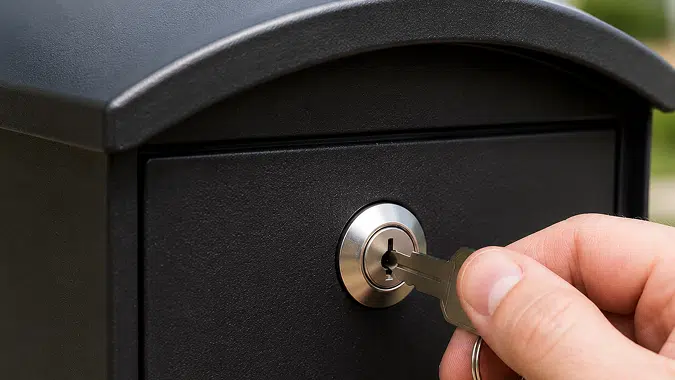
This procedure applies only to privately owned mailboxes. Attempting to open, modify, or rekey a USPS-owned cluster box is a federal offense.
When to Hire a Locksmith
A locksmith is the right call in a few specific situations: the lock is corroded or jammed and won’t accept a key even if one exists, the code stamp is illegible and no manufacturer documentation is available, no compatible part is in stock and you need same-day access, or the mailbox uses a more complex cylinder than a standard cam lock.
Typical locksmith costs for a mailbox job run $75 to $150 depending on location and lock complexity. For a standard cam lock replacement, DIY is almost always faster and significantly cheaper.
One firm rule: a locksmith cannot legally service a USPS-owned cluster box or PO Box. USPS does not authorize private locksmiths to work on federally owned mail equipment. Any locksmith who claims otherwise is operating outside their legal authority on federal property.
How Much Does Mailbox Key Replacement Cost?
USPS mailbox key replacement cost runs $20 to $50 for cluster box and PO Box keys. A DIY cam lock replacement for a private mailbox costs $15 to $40 in parts. Hiring a locksmith to replace mailbox key hardware on a privately owned unit typically runs $75 to $150. Mailbox key replacement for apartment-managed units varies by property but usually falls in the $15 to $50 range.
| Scenario | Est. Cost | Timeline | What’s Required |
| Lost CBU key (1-2 of 3 keys) | $20 to $50 | 7 to 14 business days | Photo ID, proof of address, PS Form 1094 |
| Stolen CBU key (full lock change) | $50+ | 7 to 14 business days | Same as above, plus police report |
| Lost private key, spare available | $0 to $15 | Same day | Use spare, or duplicate from spare |
| Lost private key, no spare | $15 to $150 | Same day to 5 days | DIY cam lock ($15 to $40) or locksmith ($75 to $150) |
| Apartment-managed mailbox | $15 to $50 | Hours to several days | Contact property manager; check lease for cost responsibility |
One cost factor that catches people off guard: if all three USPS-issued keys have been lost, the fee increases because a full lock change is required, not a simple key reissue. Clarify which situation applies before you visit the post office. The difference between a key reissue and a full lock change can push the cost from the low end of the range to well beyond $50 depending on your branch.
How Long Does It Take to Get a New Mailbox Key?
How long USPS mailbox key replacement takes depends entirely on your mailbox type. For a USPS new mailbox key request on a CBU or PO Box, expect 7 to 14 business days from the date you submit PS Form 1094. Other paths are significantly faster.
- USPS CBU or PO Box: 7 to 14 business days from the date you submit PS Form 1094. USPS will contact you when the key is ready. Pickup is in person at the same branch. There is no mail delivery option for replacement keys.
- Apartment or HOA mailbox: Hours to several days, depending on how quickly your property manager responds and whether they have keys on hand.
- Private mailbox, DIY cam lock: Same day if the part is on hand. Two to five days with standard shipping if you need to order.
- Locksmith: Same day in most cases.
Three practical steps worth taking while you wait: set up USPS Informed Delivery to receive daily email previews of incoming mail, request a temporary mail hold through USPS if your wait extends beyond a few days, and check your mailbox address periodically for misdirected or misdelivered mail that may have arrived during the replacement window.
What to Do If Your Mailbox Key Was Stolen (Not Just Lost)
Understanding what to do if your mailbox key is stolen starts with one distinction: this is a security incident, not a maintenance issue. A lost USPS mailbox key is one thing. A stolen one is another entirely. The urgency is higher than a standard lost-key situation because someone may already have access to your mail and personal information.
Recommended sequence:
- File a police report. This creates a paper trail and is sometimes required by USPS before they’ll prioritize a lock change at your address.
- Notify your local postmaster in person. Explain clearly that the key was stolen, not lost. USPS can flag the address for priority lock replacement and increased carrier attention.
- Contact the USPS Postal Inspection Service. If you suspect mail has been taken, file a report at uspis.gov. The Postal Inspection Service handles federal mail theft investigations.
- Sign up for USPS Informed Delivery. The daily email preview lets you track what should have arrived compared to what actually did.
- Review recent financial statements. Identity theft through stolen mail moves fast. Check bank accounts and credit reports within the week.
For more on protecting your mailbox against targeted theft and break-in attempts, see our resource on preventing mailbox break-ins.
Most sources treat a stolen key the same as a lost key. They’re not the same. A stolen key is evidence of a deliberate act. The response should reflect that.
How to Avoid Losing Your Mailbox Key Again
A lost mailbox key is rarely a one-time event for people who don’t change their habits after the first time. A few consistent practices keep your mailbox key secure and eliminate the replacement process entirely.
- Designate a key spot at home. A hook near the front door or a consistent bowl on the entryway table works. Somewhere that never changes. Keys without a designated home get lost.
- Photograph your lock code. Find the lock-code stamp on your key or lock face and save the photo to your phone. Next time you lose a key, that photo means a $15 replacement order rather than a $40 cam lock replacement.
- Make a spare and store it securely. For private mailboxes, a spare with a trusted neighbor or in a home safe removes the lock-change scenario entirely.
- Use a key tracker. Bluetooth trackers clip to a keyring and can be located via smartphone. Worth the $20 to $30 investment if lost keys are a recurring problem.
- Store keys securely when traveling. A dedicated travel pouch or a small lockbox in your luggage keeps your mailbox key separate from items that are easy to misplace or leave behind in a hotel room.
- Account for your USPS three-key set. If USPS issued you three keys and you’ve already lost one, plan your backup strategy now, not after you’ve lost the second.
For an end-to-end look at mailbox security, including lock types, anti-theft features, and upgrade options, see the complete guide to USPS mailbox locks and keys.
Need a More Secure Mailbox? Explore Locking Options
If this experience has surfaced a longer-standing concern about your current mailbox setup, you’re not alone. Key loss events often point to a mailbox that’s overdue for an upgrade.
MailboxWorks has been an authorized retailer since 1989, carrying Florence, Salsbury, AMCO, Whitehall, and Architectural Mailboxes, the brands that consistently appear on USPS-approved product lists. Browse our high-security locking mailboxes to compare residential and multi-unit options, or explore our commercial mailbox replacement parts catalog for CBU lock kits, cam lock replacements, and compatible components across all major manufacturers. For a deeper look at mailbox security features, lock types, and what to look for in a replacement unit, see our complete guide to USPS mailbox locks and keys. If you’re not sure which option fits your situation, our team can help you identify the right match.
Frequently Asked Questions About USPS Mailbox Key Replacement
How do I get a replacement mailbox key from USPS?
Visit your local post office in person with a government-issued photo ID and proof of address for the mailbox location. Complete PS Form 1094 (Application for Post Office Box Key or Lock) at the counter or download and fill it out beforehand. Pay the $20 to $50 replacement fee. USPS will notify you when the key is ready for in-person pickup, typically within 7 to 14 business days.
How much does it cost to have a mailbox key replaced?
USPS-owned CBU or PO Box key replacement runs $20 to $50 depending on your location and whether a full lock change is required. A DIY cam lock replacement for a privately owned mailbox costs $15 to $40 in parts. Hiring a locksmith for a private mailbox typically runs $75 to $150. Apartment-managed replacements vary by property but usually fall in the $15 to $50 range.
Is there a universal key for mailboxes?
No, not for personal residential use. However, USPS carriers do use a federally controlled arrow key to access the main carrier door on cluster boxes during mail delivery. That key is not available to the public and does not open individual tenant compartments. No universal key exists that residents can use to access their own mailbox compartment.
How do I get a new key made for my mailbox?
It depends on who owns the mailbox. For USPS-owned CBUs and PO Boxes, visit the post office with photo ID and PS Form 1094. For privately owned mailboxes, locate the lock-code stamp on your key or lock cylinder and order a replacement from the manufacturer. If the code is unreadable, replace the cam lock entirely. It’s a 15 to 20 minute DIY job for most standard residential models.
How long does it take to get a new USPS mailbox key?
Typically 7 to 14 business days from the date you submit PS Form 1094 at the post office. USPS processes the request and notifies you when the key is ready. Pickup is in person at the same branch where you filed. There is no delivery option for replacement keys.
Can a locksmith replace a USPS mailbox key?
No. USPS does not authorize private locksmiths to service, rekey, or replace locks on federally owned mail equipment, including cluster box units and PO Boxes. Locksmiths can only legally work on mailboxes that the individual or property owner controls directly. Any locksmith who claims otherwise is operating outside their legal authority on federal property.
Can I open my USPS mailbox without a key?
There is no legal way to open a USPS mailbox without a key. Picking the lock, prying the door, or forcing entry on federal mail equipment is a federal offense under 18 U.S.C. Section 1705, regardless of whether it is your own compartment. The only authorized path is PS Form 1094 through your local post office, or through your property manager for apartment and HOA-managed mailboxes.
Categorized in: Mailbox Tips & General Information