
Mail Theft Prevention: How to Protect Your Mailbox
Why Mail Theft Is Rising and What It Costs You
Mailbox theft prevention starts with knowing the size of the problem. From fiscal year 2023 through 2025, the U.S. Postal Inspection Service received more than 800,000 mail theft complaints, according to a May 2026 audit by the USPS Office of Inspector General. From 2019 to 2024, Postal Inspectors arrested almost 9,300 suspects for mail and package theft, the Postal Inspection Service reports.
The trend hasn’t settled, either. USPS mail theft complaints dipped in fiscal 2024, then rose again in 2025 in every inspection division but one.
So what is mail theft? It’s taking mail from a mailbox, a collection box or a carrier before it reaches the person it’s addressed to. In a mailbox theft, the envelope is rarely the loss. The loss is what’s inside: a check a thief can alter, or account details that open the door to identity theft.
This guide covers how thieves get in, the habits and hardware that stop them, and what to do after a theft.
How Mail Thieves Actually Get Into Your Mailbox
Thieves stealing mail rely on four methods. Each one targets a different weak point, so the method that hit you tells you what to fix.
Prying and Peeling Open a Curbside Mailbox
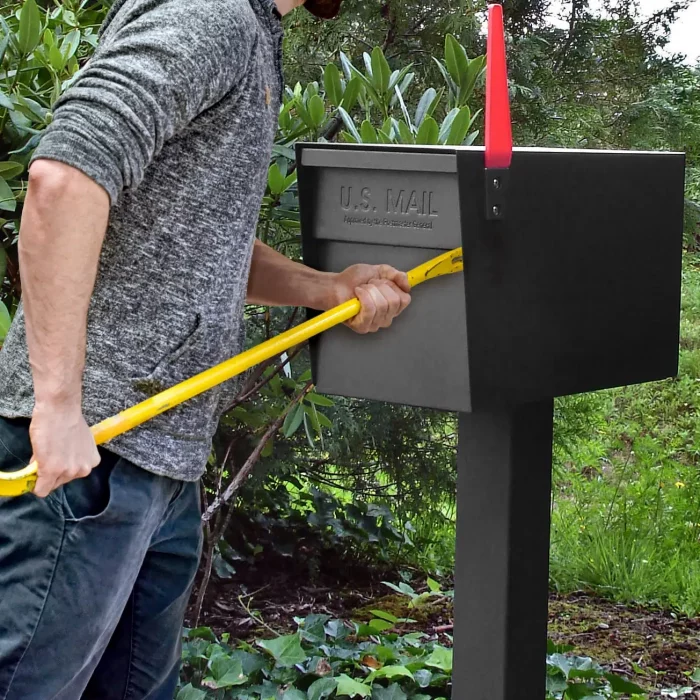
Prying is the simplest attack. On a thin aluminum or plastic box, a screwdriver bends the door or snaps the latch. Stealing mail from a mailbox like that takes no skill.
A lock on a thin door doesn’t solve it. Pry attacks usually bend or break the latch, so the door and latch give way long before the lock does.
Mail Fishing From Slots and Collection Boxes
Mail fishing uses a glue trap or a glue-coated weight on a string, often called a mailbox theft trap. The thief drops it through the intake slot and pulls it back out with envelopes stuck to it.
It works on blue USPS collection boxes and on home mailboxes with large, open slots. Watch for the tell: sticky residue around a collection box slot is worth reporting.
Check Washing After the Theft
What is check washing? It’s a type of fraud that starts with a stolen check. The thief soaks it in chemicals that lift the ink. Then they write in a new payee and amount, and deposit it.
The sign is a check that cleared, but the person you paid says it never arrived. Check washing fraud is why thieves target outgoing mail.
Arrow Key Theft and High-Volume Attacks
An arrow key is a universal USPS key. It opens collection boxes, apartment panels and cluster box units across a set area. One stolen key can put a whole neighborhood’s mail at risk, not just one household’s.
In 2023, USPS announced it would replace 49,000 arrow locks with electronic locks. You can’t control this risk as a homeowner, and we’d rather say so plainly. It’s the main reason a private, individually keyed box matters more than a shared one.
How to Prevent Mail Theft: 9 Steps That Work
Knowing how to prevent mail theft comes down to your habits, the way you send mail and the box itself. Each step carries a cost label, so you can start on the free ones today.
Habits That Cost Nothing
- Collect your mail the day it arrives (Free). Never leave it in the box overnight.
- Request USPS Hold Mail before any trip (Free). The post office keeps your mail until you’re back.
- Contact the sender when expected mail is late (Free). If a check, card or bill doesn’t show up, call the sender or issuing agency right away.
- Sign up for Informed Delivery (Free). USPS emails you a preview of the letters due each day, so you’ll know when something goes missing.
Keep outgoing mail out of your curbside box, too. A raised red flag tells your carrier to stop, but it also tells anyone driving past that mail is waiting.
Changes to How You Send Mail
How to prevent check washing starts with keeping checks out of reach.
- Hand outgoing mail to your carrier or use the lobby slot inside the post office (Free). Skip your own box. If you use a blue collection box, mail before the last pickup so nothing sits inside overnight.
- Never send cash (Free). Use a payment you can trace.
- Move recurring payments off paper checks (Free to low cost). Online bill pay takes the check out of the mail. When you must write one, use permanent black gel ink and fill in every field.
Hardware Upgrades Worth Paying For
- Replace an unsecured box with a locking one (Hardware investment). Look for a solid door and an anti-pry latch, not just a lock on a thin door. Compare the latch and steel on our locking mailboxes built to resist prying.
- Add a parcel drop if packages go missing (Hardware investment). If a stolen mail package is your problem, choose a locking model from our parcel mailboxes and drop boxes to keep deliveries behind a lock. When you ship something valuable, ask for Signature Confirmation or Hold for Pickup.
A security camera is a useful mailbox theft deterrent, but be clear about what it does. It records a theft. It doesn’t prevent one.
Your neighbors are the last layer. Start a neighborhood watch or a group chat, and share what you see: a car trailing the mail truck, a pried box, missing deliveries. Report patterns to the police together. One neighbor’s alert can protect the whole block.
What Makes a Mailbox Genuinely Theft-Resistant
A theft-resistant mailbox has a feature for each attack. Use this table to check your current box or the one you plan to buy.
| Attack method | What it exploits | Feature that stops it | Where to look for it |
|---|---|---|---|
| Prying the door | A simple tongue latch on a thin door | Anti-pry latch | Latch description on the product page |
| Peeling or bending the body | Thin aluminum, plastic or light sheet metal | Heavier steel (a lower gauge number) | Material and gauge in the specifications |
| Mail fishing | A large, open intake slot | Baffled or angled intake | Photos of the slot and the box interior |
| Attacking the lock | A basic, low-security cylinder | A higher-security wafer or tubular lock | Lock type in the specifications |
| Stolen master key | One carrier key that opens many boxes | An individually keyed private box | Single-family box, not a shared panel |
Anti-Pry Latches and Steel Gauge
The latch and the door skin matter more than the lock. A simple tongue latch is a flat metal tab that a pry bar can bend out of its catch. A hooked or cam-style anti-pry latch grips the frame, so the bar pulls against steel instead.
Gauge measures steel thickness: the lower the number, the thicker and harder to bend the metal. When you compare locking mailboxes built to resist prying, check the gauge on each product page, because it varies from model to model.
Intake Slots That Defeat Fishing
A baffle is a plate or angled chute inside the intake slot. It lets mail drop in but blocks a line or a hand from reaching the mail below. A locked box with a large, open slot brings the fishing risk right back.
Through-wall mail slots remove the outdoor box altogether. Mail passes through your wall or door and lands inside your home.
Our guide to mail slot mailboxes for your home shows five styles, including a letter slot with a locking collection box.
Lock Types and What Each One Resists
Most mailbox locks are cam locks: the key turns a flat cam that holds the door shut. The cylinder inside sets the security.
A basic wafer cylinder, built from flat discs called wafers, is the easiest to defeat. Higher-security wafer cylinders resist more. Tubular locks, which take a round key, also resist picking better than a basic wafer lock.
Your own box opens with its own key. A gang-style panel opens for the carrier with one master key, so a better lock on your door can’t fix the arrow key risk. Our guide to USPS mailbox locks and keys covers replacements.
Will USPS Deliver to a Locking Mailbox?
Yes. USPS delivers to a locking mailbox as long as the carrier can put mail in without a key. USPS doesn’t allow locks or locking inserts on a non-locking curbside mailbox if they make the carrier use a key or shrink the space inside the box. The local postmaster can’t make an exception.
If the carrier can’t get mail into the box, the carrier won’t deliver to it. Store-bought curbside mailboxes need USPS approval, and a box you build yourself needs your local postmaster’s OK, as these USPS mailbox regulations and requirements explain.
Before you install a curbside box, contact your local post office to confirm its height and position.
What to Do If Your Mail Is Stolen
Act fast, in this order: report to the Postal Inspection Service, file a police report, then protect your accounts.
Report It to the Postal Inspection Service
Who investigates mail theft? The U.S. Postal Inspection Service, the law enforcement arm of USPS. Here’s how to report mail theft: use the online form at uspis.gov/report or call 1-877-876-2455. If you see a crime in progress, call 911.
Pick the right channel. A late or lost item that wasn’t stolen is a USPS service issue. A theft is a crime, so report stolen mail to the Postal Inspection Service.
File a Local Police Report
A local report still matters. Your bank may ask for a copy, and it helps police spot a pattern on your street. Here’s how to report mail theft to police:
- Gather any evidence: photos of the box, camera footage, dates and times.
- File through the non-emergency line or the department’s online portal.
- Ask for a copy of the report and keep the report number.
Protect Your Accounts and Identity
Contact the issuer of anything that went missing, such as your bank or card company. Then place a free fraud alert or credit freeze with the credit bureaus. Watch your statements for a check that cleared but never reached the person you paid.
Confirm that no one filed a change of address in your name. If a mailbox key went missing, change the lock before you trust the box again. Here’s how to replace a stolen or lost mailbox key.
Is Mail Theft a Federal Crime?
Yes. Under 18 U.S.C. 1708, stealing mail carries a fine, up to five years in prison, or both. Since a 1952 amendment, mail theft has been a felony no matter how little the stolen item was worth.
The same section covers possession of stolen mail. Anyone who knowingly buys, receives or holds stolen mail faces the same five-year maximum. The dollar limit comes from a separate law, 18 U.S.C. 3571, which allows a fine of up to $250,000 for an individual convicted of a felony.
Tampering with mail is a federal crime, too. Taking mail before delivery to open, hide or destroy it falls under 18 U.S.C. 1702, with up to five years in prison. Breaking open or destroying a mailbox falls under 18 U.S.C. 1705, with up to three years.
Mail Theft Prevention in Apartments and Shared Mailrooms
If you rent or live in an HOA, you may not own your mailbox. You can still ask for changes. Put these requests in writing to your property manager or HOA board.
- Brighter lighting at the mail panel
- Moving the panel indoors or to a more visible spot
- Replacing a damaged or pried panel
- New locks for every affected box after a break-in, on a set schedule

Ownership decides who handles the locks. A homeowner looks after their own curbside box.
USPS provides locks and keys for the cluster box units it owns. For private units, the builder or property owner does. Ask who owns yours before you ask for repairs.
Three homes can share one post without sharing a lock. The Mail Boss Triple Mount locking mailboxes with post give each household its own box. Each box has an anti-pry latch, a high-security lock and 12- and 14-gauge galvanized steel.
Larger buildings can upgrade to apartment mailboxes with a separate lock for each tenant door.
Upgrade Your Mailbox With MailboxWorks
Good mail theft prevention comes down to a box with an anti-pry latch, heavy steel, a baffled slot and a quality lock. Browse our locking mailboxes built to resist prying, or wall mount mailboxes if your carrier delivers to the house.
Want a second opinion first? Call our team at 1-866-717-4943. We’ll help you choose a mailbox that stands up to thieves and still looks right on your home.
Tags: Mailbox SecurityCategorized in: Locking Mailboxes, Mailbox Tips & General Information