
USPS Mailbox Regulations & Requirements: 2026 Guide

In this guide, you’ll find every USPS mailbox regulation in one place: commercial, multifamily, and residential. Whether you’re planning new construction for a multifamily property, managing compliance for an HOA, or replacing a curbside mailbox at home, the USPS mailbox regulations that apply to your project are all here. We cover CBU and STD-4C standards for commercial properties, ADA compliance with USPS height requirements, parcel locker ratios, curbside placement specifications, wall mount guidelines, locking mailbox requirements, rural regulations, and federal mailbox law.
Note: All specifications referenced in this guide are drawn from the USPS Domestic Mail Manual (DMM § 508), the official regulatory document governing mailbox standards.
USPS Mailbox Regulations at a Glance
USPS mailbox requirements cover both commercial and residential installations. Curbside mailboxes must be positioned 41–45 inches from the road surface, set back 6–8 inches from the curb, and approved by the Postmaster General. Commercial properties must follow mailbox rules and regulations requiring STD-4C or USPS-licensed CBU equipment for new construction, with one parcel locker per five compartments.
| Category | Regulation | Requirement |
| Commercial: New construction | Mailbox system type | STD-4C (wall-mounted) or USPS-licensed CBU |
| Commercial: Renovation | 4B+ replacement eligibility | One-to-one replacement only; 4C required if rough opening is disturbed |
| Commercial: Parcel lockers | Ratio requirement | 1 parcel locker per 5 mailbox compartments (effective July 2020) |
| Commercial: ADA compliance | Forward reach range | 15–48 inches from finished floor; 30″ x 48″ clear floor space |
| Residential: Curbside height | Bottom of mailbox | 41–45 inches from road surface |
| Residential: Curbside setback | Mailbox door to curb face | 6–8 inches |
| Residential: Post material | Approved supports | 4×4 wood or 2-inch diameter steel/aluminum pipe |
| Residential: Address numbers | Minimum numeral height | 1 inch, visible from street |
| Residential: Wall mount | Mail capacity | Must hold one normal day’s mail |
| Residential: Door slot | Opening dimensions | Minimum 1.5″ H x 7″ W; bottom at least 30″ above floor |
| Residential: Locking mailbox | Mail slot minimum | 1.75″ H x 10″ W; PMG-approved or postmaster-approved |
Complete construction and testing requirements for each size classification are published in the USPS Engineering Standards and Specifications.
Commercial & Multifamily Mailbox Regulations
USPS now requires centralized mail delivery for nearly all new commercial and multifamily construction. Individual door-to-door delivery is no longer the standard for these properties, and USPS mailbox regulations for multifamily residences are more detailed than many builders and property managers expect. The two equipment types that satisfy this requirement are CBUs (cluster box units) for outdoor, freestanding installations and STD-4C mailboxes for wall-mounted configurations.
Commercial mailbox regulations are clear on one point: the builder or developer is responsible for purchasing, installing, and maintaining the mailbox equipment. Once the property is occupied, that responsibility transfers to the property owner or HOA.
The sections below cover 4C standards, CBU requirements, parcel locker ratios, ADA compliance, and planning coordination with USPS per the Postal Operations Manual Section 632, structured around the decisions that builders, property managers, and architects actually face. Browse our full range of commercial mailboxes for compliant options across both equipment types.
4C (STD-4C) Mailbox Standards for New Construction
The STD-4C became the mandatory USPS standard for all new construction and major renovations as of October 5, 2006, replacing the older 4B standard. Understanding current USPS 4C mailbox requirements starts with the key structural change: minimum compartment size increased to 12 inches wide x 15 inches deep x 3 inches high, and the vertical form factor (narrow stacked columns) was eliminated entirely from USPS-serviced installations.
USPS STD-4C compliant mailbox systems come in three configurations:
- Recessed: Built into the wall. Pre-approved by USPS with no additional postmaster sign-off required.
- Surface-mount: Attached to the wall face. Requires local postmaster approval before installation.
- Freestanding (Depot): Pedestal-mounted, used in parking areas or building lobbies. Also requires local postmaster approval.
All 4C mailbox units must pass USPS security testing before they qualify for installation. The confirmation to look for: a “U.S. Mail” label on the unit. No label, no approval.
For renovations where an existing mailbox system is being replaced within the same rough wall opening with no structural changes, 4B+ equipment may still qualify under direct replacement rules. Any alteration to the rough opening triggers the 4C requirement. When in doubt, confirm with your local postmaster before ordering equipment.
Full specifications and installation guidance are available in the 4C mailboxes FAQ. Browse the complete range of compliant commercial mailboxes.
CBU Cluster Box Unit Requirements
A CBU mailbox is a freestanding, pedestal-mounted outdoor unit designed for centralized delivery in residential developments, apartment communities, and commercial properties. The distinction from standard approved mailboxes matters: CBUs must be USPS-licensed, a more stringent designation that covers equipment type, manufacturer qualification, and installation site.
Understanding USPS cluster mailbox requirements starts with the available configurations: 8, 12, 13, and 16 compartments. Each unit includes a master door for USPS carrier access and an outgoing mail slot for residents. The pedestal mounts to a concrete pad and is bolted in place. Security features on current USPS-licensed units include anti-pry door reinforcement, an anti-fishing comb at the mail slot, and a sloped hood on the outgoing slot.
Key points to know before specifying CBUs, including current cluster mailbox regulations:
- Site approval required. A USPS Growth Manager must approve both the site and the equipment type before installation proceeds.
- Do not number doors to match units. Mailbox door numbers should not correspond to apartment or unit numbers. This is a USPS security and privacy standard.
- CBUs must be purchased by the builder, developer, or property owner for their centralized delivery installation. Major manufacturers include Florence, Salsbury, and Postal Products Unlimited, all of which produce USPS-licensed units.
For a full breakdown of how CBU systems work and what to plan for, see our guide on how cluster mailboxes work.
4B/4B+ Mailbox Replacement Rules
4B mailbox replacement is the only approved use for 4B+ horizontal and vertical mailboxes in USPS-regulated installations: direct, one-to-one replacement of an existing unit in an existing rough opening with no structural alteration.
They are not approved for new construction. They are not approved for major renovations. If your project disturbs the wall rough opening at all, you are required to install STD-4C compliant equipment.
Two additional rules apply:
- USPS will not install Arrow locks in 4B+ equipment purchased for a new installation rather than a direct replacement. If the unit does not qualify as a genuine replacement, the Arrow lock will not follow.
- Before altering any existing mail system, including a like-for-like swap, get written approval from your local postmaster first. This protects your timeline.
For any mailbox regulations renovation projects must comply with, the safest position is to assume 4C is required until your local post office confirms otherwise. Browse apartment mailboxes for compliant options covering both replacement and new construction scenarios.
Horizontal Mailbox Regulations
Horizontal mailboxes, also called horizontal apartment mailboxes, are the traditional wall-mounted format with wider compartments arranged in rows. Before the 2006 STD-4C mandate, this form factor was the standard for large multifamily and commercial mail delivery.
Under current USPS regulations, horizontal mailboxes in the 4B+ standard are approved only for direct one-to-one replacement of existing installations. New construction requires the 4C horizontal mailbox format, which carries larger minimum compartment dimensions (12 inches wide x 15 inches deep x 3 inches high) and is the current USPS-approved standard for all new projects.
For private delivery applications at universities, military installations, and corporate campuses where USPS does not directly service the mailboxes, the older horizontal formats remain viable. Florence’s 1600 series (front-loading) and 1700 series (rear-loading) are widely used in those contexts.
If your installation is USPS-serviced: 4B+ horizontal for direct replacement only; 4C horizontal for everything else. See commercial mailboxes and apartment mailboxes for compliant options.
Vertical Mailbox Regulations
Vertical mailboxes feature narrow, tall compartments stacked in columns. They were the dominant form factor in apartment buildings constructed before 2006 and remain common in older urban properties.
The STD-4C standard eliminated the vertical mailbox unit USPS installations previously relied on entirely. The old vertical compartment size, approximately 5 inches wide x 6 inches deep x 15 inches high, does not meet current requirements. Vertical 4B+ mailboxes are approved only for direct one-to-one replacement in existing buildings where the rough wall opening is not being altered.
For any new construction, or any renovation that changes the wall opening, the property must transition to STD-4C horizontal mailboxes. There is no vertical equivalent in the current 4C standard.
As a vertical wall mount mailbox remains appropriate for private delivery installations not serviced by USPS, university dorms, internal corporate mail systems, and military bases continue to use them widely. If you’re managing a building that still has vertical units and a renovation is coming, the 4C mailboxes FAQ covers the replacement threshold in detail.
Parcel Locker Requirements
Meeting parcel locker requirements USPS mandates starts with one rule: as of July 2020, one parcel locker is required for every five mailbox compartments in all centralized mail installations, both 4C and CBU configurations. This is not optional, and it catches developers off guard more often than any other item in the compliance checklist.
The USPS parcel locker ratio in practical terms: a building with 30 mailbox compartments needs a minimum of 6 parcel lockers. A development that plans for 2 and orders equipment accordingly is facing a compliance failure and a project delay.
Key rules governing parcel locker installation:
- Parcel lockers may be integrated within individual mailbox modules or grouped as a separate bank near the mailbox area.
- The lock system on parcel lockers is captive. USPS regulations prohibit modification for any purpose other than parcel delivery.
- Installations with fewer than 5 compartments may have the requirement waived at the postmaster’s discretion.
Budget for parcel lockers at the 1:5 ratio from the project planning stage. Retrofitting after equipment is ordered is an expensive problem to solve.
Which Mailbox Type Does USPS Require for Your Project?
Not sure which mailbox does USPS require for your specific project? Use this table to determine the correct equipment type before purchasing. USPS mailbox requirements vary depending on whether you are building new, renovating, or doing a direct replacement.
| Project Scenario | Required Equipment |
| New construction, multifamily or commercial | STD-4C or USPS-licensed CBU |
| Major renovation (rough opening altered) | STD-4C required; 4B+ not acceptable |
| Direct replacement, same rough opening, no structural change | 4B+ acceptable; get postmaster confirmation first |
| Indoor installation | STD-4C (wall-mounted configurations) |
| Outdoor, freestanding installation | USPS-licensed CBU |
| Private delivery only (USPS does not service the property) | No USPS regulation applies |
If your project does not fit one of these rows cleanly, contact your local postmaster before ordering. USPS has authority to deny mail service to properties with non-compliant equipment, and that denial can delay a certificate of occupancy.
ADA & Fair Housing Accessibility Requirements for Mailboxes
ADA mailbox requirements and USPS height rules overlap, and when they conflict, the stricter standard applies. That standard is almost always ADA.
USPS allows mailbox installations up to 67 inches in height. ADA forward reach requirements, outlined in the ADA Standards for Accessible Design, cap accessible reach at 48 inches from the finished floor. For properties subject to the Americans with Disabilities Act or Fair Housing Act, the effective installation ceiling is 48 inches, not the USPS maximum.
Specific ADA requirements governing mailbox accessibility for compliant installations:
- Forward reach range: 15–48 inches from finished floor for accessible compartments
- Clear floor space: 30 inches x 48 inches in front of mailbox panels
- Minimum ADA-compliant compartments: At least 5% of total compartments must be accessible
Standard CBUs have upper compartments exceeding 48 inches. Those positions are not ADA compliant. Properties meet apartment mailbox regulations for accessibility through sequential compartment numbering, which provides flexibility to assign residents with mobility limitations to lower compartments. The mailbox itself does not need to be reconfigured; the assignment practice determines compliance.
The practical installation guideline: mount mailbox panels so no required accessible compartment exceeds 48 inches from finished floor. Our USPS and ADA compliance guide covers this interaction in full, including documentation practices for property managers.
Centralized Delivery Planning for Builders & Developers
Engage your local USPS Delivery Planning Manager early in the design process, ideally during schematic design rather than after permits are pulled. Good usps delivery planning at the project outset eliminates the risk of USPS denying mail service to properties with non-compliant infrastructure. For a multifamily development, that denial can hold up a certificate of occupancy.
The responsibilities break down this way:
- Builder/developer: Responsible for purchasing and installing approved mailbox equipment.
- Property owner: Responsible for ongoing maintenance, repair, and replacement after occupancy.
Additional centralized delivery requirements before USPS will initiate mail service:
- CBUs must be located within one block of the residences they serve.
- Street signs must be installed and house numbers displayed before delivery begins.
- Equipment sites and types require Growth Manager approval.
USPS publishes its standards in the USPS Delivery Planning Guide (PO-632) and the Postal Operations Manual, Section 632, the primary reference documents for builder and developer planning. Browse commercial mailboxes for compliant CBU and 4C options.
HOA & Property Manager Responsibilities
Understanding HOA mailbox regulations starts with one principle: once a property is built and occupied, mailbox compliance responsibility shifts to the HOA or property owner. That means budgeting for maintenance, not just installation.
Core property manager mailbox responsibilities include:
- Regular inspection of mailbox units for physical damage, wear, and door function
- Prompt lock replacement when residents report lost keys; a compromised Arrow lock is a security issue USPS takes seriously
- Coordination with the local post office when regulatory changes require equipment updates
- Full compliance with current USPS standards when upgrading or replacing any mailbox equipment
- Planning for parcel locker expansion as package delivery volumes grow; the 1:5 ratio was updated in 2020 and further guidance changes are possible
For HOAs, the neighborhood mailboxes guide for HOAs covers the governance and maintenance side of community mailbox management. For property managers handling larger multifamily portfolios, our guide to managing community mailboxes is a practical operational reference.
Residential Mailbox Regulations
Usps residential mailbox regulations apply to single-family homes receiving curbside or walk-up delivery. The rules cover placement, construction standards, post materials, size classifications, wall mount installation, door slot dimensions, locking mailbox requirements, and rural-specific variations. These mailbox regulations are more detailed than most homeowners expect.
The baseline requirement across all curbside residential mailboxes: the unit must bear the Postmaster General (PMG) seal of approval. This seal confirms the mailbox has been tested and certified to meet USPS mailbox regulations for construction standards. Mailboxes without it are not eligible for USPS delivery service.
Curbside Mailbox Height and Placement Requirements
Getting mailbox height requirements right starts with one commonly misread spec: USPS requires the bottom of the mailbox, not the top, to sit 41 to 45 inches above the road surface. Not above the ground where your post sits. Above the road.
This distinction matters on sloped driveways, graded lots, and roads with raised curbs. The measurement is always taken from the road surface at the point where the carrier’s vehicle will stop, straight up to the bottom edge of the mailbox opening. A post set in ground lower than the road surface will need to be taller than expected to hit the correct height.
Full usps mailbox placement rules for curbside installations:
- Height: 41–45 inches from road surface to bottom of mailbox
- Setback: 6–8 inches from the curb face to the mailbox door, measured to the face of the door, not the post
- Road positioning: Right-hand side of the road in the direction of carrier travel
- Access: The approach path to the mailbox must be clear of obstructions at all times
These usps mailbox height regulations apply regardless of terrain. Before installing a new mailbox or relocating an existing one, contact your local postmaster. Placement on specific roads may require adjustment based on traffic conditions, rural delivery routes, or local carrier access requirements. A call before you dig avoids having to move the post afterward.
For official USPS placement standards, see How to Install a Mailbox on USPS.com. For step-by-step installation guidance, the curbside mailbox installation guide covers post depth, anchoring, and alignment.
Mailbox Post and Support Standards
Meeting mailbox post requirements starts with material selection. USPS approves two post types for curbside residential installations: a 4×4 wood post or a 2-inch diameter round steel or aluminum pipe. Browse mailbox posts for compliant options in both materials.
Maximum bury depth is 24 inches, and the post must not extend beyond the front face of the mailbox.
One frequently overlooked requirement: the post must be designed to yield on impact. Per Federal Highway Administration guidelines, breakaway or yield-on-impact supports are required for mailboxes installed within the road right-of-way. Concrete posts, heavy steel pipes, farm equipment repurposed as supports, and decorative masonry structures do not meet this standard and carry liability exposure alongside the compliance issue.
Prohibited supports: heavy metal pipe beyond the standard 2-inch diameter, concrete footings with rigid ground anchoring, and any structure that would not yield under vehicle impact.
For installation depth, anchoring, and a breakdown of the two main approaches (the Farmer Method and the Engineer Method), see the curbside mailbox installation guide.
USPS Mailbox Size Regulations (T1–T4)
Usps mailbox size regulations classify curbside mailboxes into four tiers. All four must carry the PMG seal to qualify as a usps approved mailbox eligible for delivery service.
| Size Class | Approximate Dimensions | Typical Use |
| T1 Small | ~6″ W x 19″ D x 8.5″ H | Compact urban lots, light mail volume |
| T2 Medium | ~8″ W x 22.5″ D x 10.5″ H | Standard residential; most common |
| T3 Large/Rural | Larger width and depth | Rural routes, higher mail volume |
| T4 Extra Large | Largest classification | High-volume delivery, package-capable |
For homeowners with a non-standard mailbox design, such as custom fabricated units, ornamental boxes, or historically significant replacements, USPS offers a custom approval process through the local postmaster. Submit the physical mailbox or detailed plans for review and get written approval before installation.
Browse large mailboxes for PMG-approved T3 and T4 options.
Wall Mount Mailbox Regulations
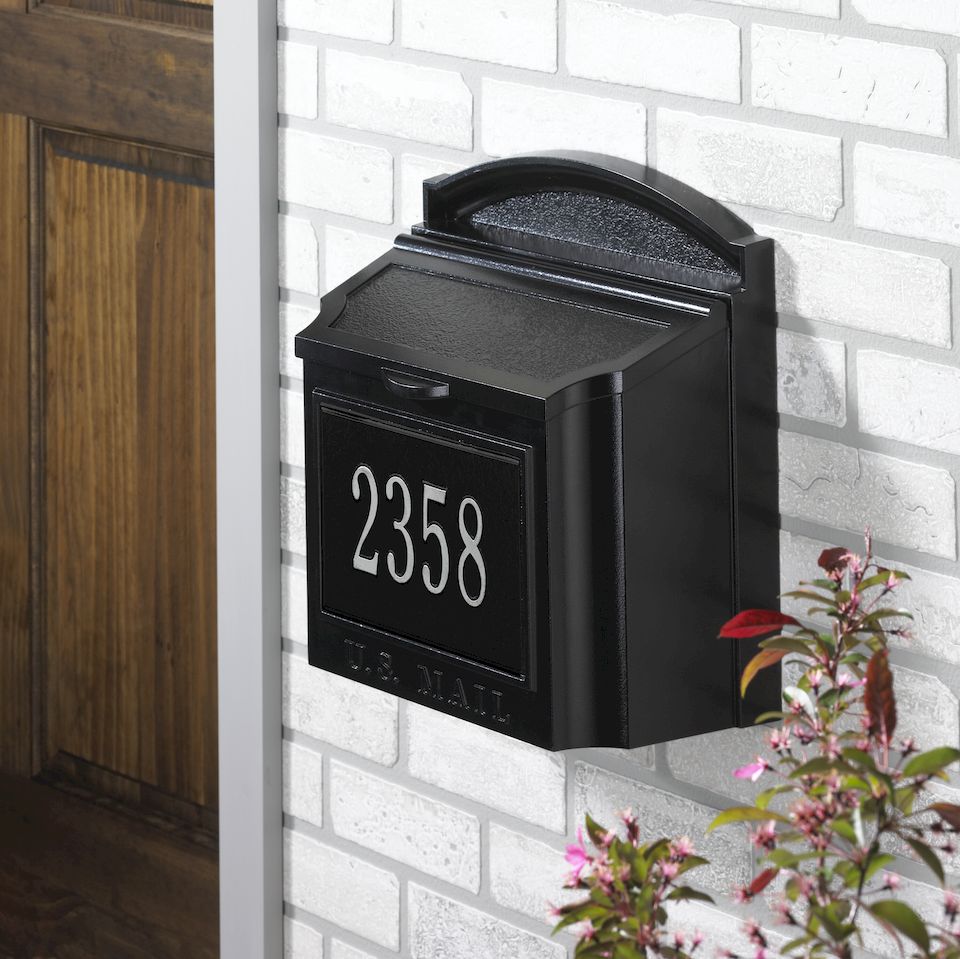
Usps wall mounted mailbox regulations are less prescriptive than curbside rules. Standard wall-mounted residential mailboxes are not subject to the PMG seal requirement that applies to curbside units. The core standards that do apply:
- The mailbox must hold one normal day’s mail without overflow.
- Place near the main entrance of the home.
- Recommended installation height is 41–45 inches from the ground to the mailbox bottom, consistent with curbside guidelines, though USPS does not enforce this as strictly for wall mounts as it does for curbside installations.
One rule specific to wall-mounted mailboxes: newspapers and advertising circulars may not be placed inside a wall-mounted mailbox designated for USPS mail. The box is for USPS items only.
Browse wall mount mailboxes for compliant residential options.
Door Slot Specifications
Current mail slot regulations set the following USPS minimums for door slot receptacles:
- Opening size: 1.5 inches high x 7 inches wide (minimum)
- Bottom of opening: At least 30 inches above the floor
- Horizontal slots: Flap hinged at the top, swinging inward
- Vertical slots: Flap hinged on the side opposite the door opening direction
These door slot USPS requirements apply to all residential door slot installations. Slots that fall below the minimum opening size may result in mail being held at the post office. If you’re replacing an existing slot, measure the opening before ordering. Older installations frequently fall below current minimums.
See the residential mail slots guide for installation specs and compliant product options.
Locking Mailbox USPS Requirements
Understanding locking mailbox requirements starts with one rule: a locking mailbox is USPS-compliant only when it satisfies both the approval requirement and the dimensional requirements. Meeting one without the other is not sufficient.
Approval requirement: The mailbox must carry PMG approval or receive explicit written approval from your local postmaster before installation.
Incoming mail slot dimensions:
- Minimum slot size: 1.75 inches high x 10 inches wide
- Protective flaps must be oriented inward
- The slot must accommodate unfolded USPS Priority Mail flat envelopes without forcing
Following usps locking mailbox rules, USPS carriers will not open a locking mailbox, accept a homeowner’s key, or deliver to a locking mailbox with a slot that falls below minimum dimensions.
One rule that frequently surprises homeowners: locks added to traditional non-locking mailbox designs are not permitted. If you want a locking mailbox, the locking mechanism must be part of the original USPS-approved design. It cannot be retrofitted onto a standard box.
For compliant locking options, see locking residential mailboxes and our guide to USPS mailbox locks and keys.
USPS Rural Mailbox Regulations
Usps rural mailbox regulations follow the same baseline placement standards as urban and suburban installations: 41–45 inches in height, 6–8 inches of setback, right-hand road positioning. Local variation is more common in rural areas, though, and the national baseline is a starting point rather than a guaranteed final spec.
In some states and rural jurisdictions, local postmasters require 46–48 inches in height and a minimum 3-foot clearance from the road edge to accommodate larger carrier vehicles and higher-speed delivery routes. Where local postmaster requirements differ from the national standard, the local requirement takes precedence.
The T3 large mailbox is the standard size classification for rural routes, where mail volume is typically higher and package delivery is routine.
Before installing a rural mailbox, call your local post office and confirm the specific requirements for your delivery route. Rural routes vary considerably in terrain, vehicle type, and carrier access constraints, and a mailbox that meets national USPS specs may still fail local postmaster requirements.
See the post mount mailboxes FAQ for rural installation guidance.
Address Marking and Display Requirements
Mailbox number requirements are straightforward: address numbers on curbside mailboxes must be at least 1 inch tall and visible on either the front face of the mailbox or the flag side. Browse our address plaques for compliant display options. If the mailbox is located on a street different from the property’s primary address, the full address must be displayed, not just the house number.
Reflective numbers are recommended for rural routes and low-light delivery areas. USPS does not mandate reflectivity, but it reduces the chance of misdelivery on early morning or evening routes.
Following current address display regulations, advertising of any kind, including decals, signage, and painted promotions, is prohibited on both the mailbox and the post. Once installed for USPS delivery, the mailbox is a federal mail receptacle and commercial advertising on it is not permitted.
Federal Mailbox Laws: What You Need to Know
Understanding federal mailbox regulations starts with one fact: once your mailbox is installed for USPS delivery, it becomes a federal mail receptacle under 18 U.S.C. § 1708. That status carries real consequences.
Mailbox tampering, vandalism, and theft are all federal offenses, not local ordinance violations. Current mailbox laws under 18 U.S.C. § 1708 set penalties including fines and up to five years in federal prison. This applies to your own mailbox as well: unauthorized access or destruction of a USPS mail receptacle is a federal matter regardless of ownership.
Only USPS-authorized personnel may deposit items into a curbside mailbox designated for USPS delivery. Neighbors, delivery services, and third parties, including residents of your property delivering internal mail, cannot use USPS-designated receptacles.
Seasonal decorations on the outside of the mailbox are generally acceptable, provided they do not obscure address markings, block the door or flag, or interfere with carrier access.
When to Replace Your Mailbox
Knowing when to replace mailbox equipment matters as much as knowing which one to buy. At MailboxWorks, we’ve spent over 30 years helping homeowners and property managers select USPS-compliant mailbox solutions. A mailbox that looks functional may still be out of compliance. These are the signs that replacement is warranted:
- Visible physical damage: Rust penetrating the mailbox body, a bent or damaged door, or a cracked casing. A door that does not close and latch properly is a compliance issue, not just a cosmetic one.
- Does not meet current size standards: If your curbside mailbox predates the T-classification system and is significantly smaller than a T1, it may not accommodate current mail volumes.
- No PMG seal: If you cannot find the Postmaster General approval seal on your curbside mailbox, it may not be USPS-approved. Replacement with a certified unit is the right move.
- Received a postmaster notice: A written notice from your local post office is a formal compliance flag. Address it promptly. Continued non-compliance can result in held mail.
Following current mailbox replacement rules, the process is straightforward: identify the correct equipment type for your installation, confirm compliance with current USPS standards, and order from a supplier that carries certified units. For commercial properties, a compliance review is worth scheduling if your installation predates the 2020 parcel locker ratio update or the 2006 STD-4C mandate.
MailboxWorks carries compliant options across both segments: residential mailboxes and mailbox with post packages for curbside replacement, and full commercial systems for multifamily and centralized delivery upgrades.
Frequently Asked Questions About USPS Mailbox Regulations
What are USPS requirements for mailboxes?
For curbside residential mailboxes, USPS requires the bottom of the box to be 41–45 inches above the road surface, set back 6–8 inches from the curb, and bearing the PMG seal of approval. Post material must be 4×4 wood or 2-inch metal pipe. Address numbers must be at least 1 inch tall. For commercial and multifamily properties, new construction requires STD-4C or USPS-licensed CBU equipment.
Are there rules for a mailbox?
Yes. USPS regulates mailbox placement, construction, size, and access for both residential and commercial installations. Specific rules cover height, setback, post materials, address display, locking mailbox slot dimensions, and wall mount capacity. Once a mailbox is installed for USPS delivery, it is considered a federal mail receptacle under 18 U.S.C. § 1708, and tampering with it is a federal offense.
What is the new mailbox rule for USPS?
Two significant regulatory changes affect current installations. As of October 5, 2006, all new commercial and multifamily construction must use STD-4C compliant mailboxes or USPS-licensed CBUs. The older 4B standard is no longer acceptable for new builds. As of July 2020, USPS requires one parcel locker for every five mailbox compartments in all centralized mail installations.
Can I put my mailbox wherever I want?
No. Curbside mailboxes must meet specific height (41–45 inches from road surface), setback (6–8 inches from curb), and road-side positioning requirements. Placement that deviates from USPS guidelines, including installing on the wrong side of the road or at an incorrect height, can result in mail being held at the post office. Always contact your local postmaster before installing or relocating a mailbox.
Can I use a locking mailbox?
Yes, with conditions. The mailbox must be PMG-approved or approved by your local postmaster, and the incoming mail slot must be a minimum of 1.75 inches high x 10 inches wide with inward-oriented protective flaps. USPS carriers will not open locked mailboxes or accept homeowner keys. Locks retrofitted onto non-locking mailbox designs are not permitted.
What mailbox is required for new construction?
USPS requires STD-4C compliant wall-mounted mailboxes or USPS-licensed CBU cluster box units for all new commercial and multifamily construction. 4B+ mailboxes are not approved for new installations. Recessed 4C mailboxes are USPS pre-approved; surface-mount and freestanding configurations require local postmaster approval. Parcel lockers must be included at a ratio of one locker for every five compartments.
Categorized in: Mailbox Installation & Upgrades, Mailbox Tips & General Information